
Beyond AI Hallucinations: A Reliable AI-Assisted Research Workflow
TL;DR
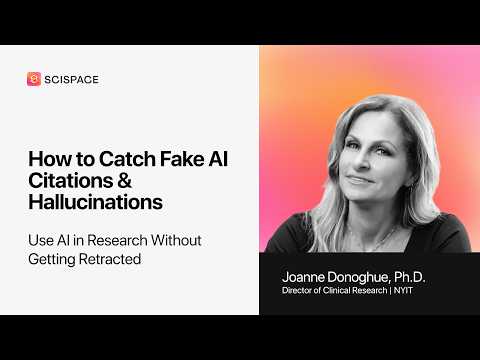
1-min readInvented references and confident but incorrect answers are among the most serious risks of using AI in research, and they can quietly weaken published work. In this tutorial, Dr. Joanne Donoghue, PhD, ACSM-CEP, Director of Clinical Research at NYIT College of Osteopathic Medicine and Associate Editor of The Journal of Electronic Gaming and Esports, explains how to build a workflow that lowers those risks. It is aimed at researchers, clinicians and students in medicine, health and other fields who use AI tools and want to avoid fabricated or inaccurate output.
Key takeaways
- AI hallucinations are outputs that sound plausible but are false, such as made-up references, misquoted findings or statistics that appear in no source.
- They occur because language models generate likely-sounding text rather than retrieving verified facts, which is why every AI-generated reference needs checking.
- General-purpose large language models and research-specific AI tools behave differently, so the choice of tool matters at each stage, from discovery and literature review to synthesis and writing.
- To avoid fake citations, prefer tools that link answers to real, retrievable papers, open each source, and confirm DOIs, authors and publication details.
- Reference lists copied from general chatbots should not be used without verification.
- Keeping the original PDF alongside your notes makes it easier to trace each claim back to its evidence.
To apply this, use SciSpace to find and read the papers behind your claims, and check each statement against its source before it enters your writing.
How to do it
Learn what hallucinations look like
Watch for made-up references, misquoted findings and statistics that appear in no source. Recognising AI hallucinations in research is the first defence against them.
Choose the right tool per stage
Pick tools deliberately for discovery, literature review, synthesis and writing, since general-purpose models and research-specific tools behave differently.
Find the papers behind your claims
Use SciSpace to find real, retrievable papers behind each claim instead of copying reference lists from general chatbots.
Open and confirm each source
Open every cited source and confirm its DOI, authors and publication details. Unverified references can quietly weaken published work.
Check statements against the original PDF
Keep the original PDF alongside your notes and check each statement against it before it enters your writing. This keeps every claim traceable to its evidence.
Watch the tutorial35 min
Chapters
- Welcome and introduction
- Why are AI-hallucinated references rising in research papers?
- Why does AI make up fake citations? How LLM hallucinations happen
- How a fake AI reference ends up in clinical guidelines
- Can AI check your references for you? Why the author is responsible
- What does an AI-hallucinated citation look like?
- Is AI biased when it picks citations? Who is most at risk
- Four more ways AI hallucinates in research: GLP-1 examples
- What happens if your paper has fake references? Journal and arXiv rules
- How to verify a DOI on doi.org and fix wrong AI citations
- Same prompt in 5 AI research tools: why the results don't match
- How to see which search terms SciSpace used, and write a better prompt
- Cross-check AI search results in SciSpace to find the strongest RCTs
- How to stop AI inventing references: chat with your own PDFs in SciSpace
- NotebookLM vs SciSpace: which should researchers use for their papers?
- Can AI write your systematic review for you?
- Should AI format your reference list? Why use Zotero or Mendeley
Try this on SciSpace
Find, Add & Audit Citations
Open agent →Literature Review Generator
Open agent →Reference Checker
Open agent →
Frequently asked questions
What are AI hallucinations in academic research?
AI hallucinations are outputs that sound plausible but are false, such as invented references, misquoted findings or statistics that do not appear in any source. They happen because language models generate likely-sounding text rather than retrieving verified facts. In research, they can lead to incorrect citations and claims, so every AI-generated reference should be checked.
How can I avoid fake citations when using AI?
Use tools that link answers to real, retrievable papers, and open each cited source to confirm it exists and says what is claimed. Check DOIs, authors and publication details. Avoid copying reference lists produced by general chatbots without verification. Keeping the original PDF alongside your notes makes it easier to trace each claim back to its evidence.
Related tutorials
 EN39 minTutorial
How to Disclose AI Use in Your Thesis or Research Paper
Professor Benita Olivier shows how to declare AI use at each stage of a real research workflow in SciSpace.
 EN45 minTutorial
Using AI in Grants and Papers Without Raising Reviewer Red Flags
Learn which AI writing patterns raise red flags with grant and journal reviewers, and how to use AI while keeping your own voice.
 EN44 minTutorial
Using AI Responsibly in Research: Trust, Evidence and SciSpace
Dr Sasha Nikolic explains how to assess AI output, verify citations and disclose AI use to protect academic integrity.