 EN27 min
Tutorial
Using AI in Scientific Writing: What to Delegate and What to Keep
Dr. Gali Halevi explains which parts of scientific writing AI can support and which decisions must stay with the researcher.
 SciSpace Academy
13experts25tutorials7languages
Good academic writing is clear argument supported by accurate evidence.
Showing 25 tutorials
EN27 minDr. Gali Halevi explains which parts of scientific writing AI can support and which decisions must stay with the researcher.
 EN33 min
Dr. Ethan James Gantana explains how to use SciSpace in scientific writing while checking reliability and protecting citation integrity.
Professor Benita Olivier breaks research paper writing into manageable stages, using SciSpace for literature, structure and drafting while keeping AI use responsible.
 EN51 min
Learn how SciSpace Agent connects literature search, drafting, citations and journal selection in one workspace for manuscript writing.
 EN43 min
Professor Benita Olivier applies her 10-step framework to the discussion section and shows where SciSpace supports three key steps.
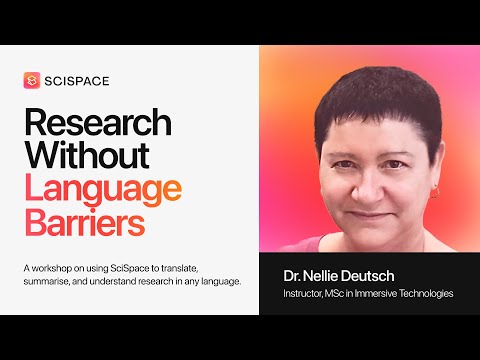 EN45 min
Dr. Nellie Deutsch shows ESL/EFL researchers how to read complex papers, paraphrase ethically and write clearer English with SciSpace.
 EN58 min
Omkar Jadhav shows how to organise sources in SciSpace Library and turn notes into a cited academic draft with AI Writer.
 EN53 min
Prof. Iain Jackson walks through building a publishable paper, from research question and IMRaD structure to revision and citation.
Kenan Kraković shows how SciSpace supports thesis structure, literature mapping, drafting and citations while keeping academic rigour.
EN51 minUse SciSpace as a manuscript co-pilot, not as the source of evidence. Build an outline that maps each section to verified data and references, use AI Writer to draft from that evidence, and review every number, citation, limitation, and interpretation before submission. The author remains responsible for the argument, scientific judgment, and final wording.
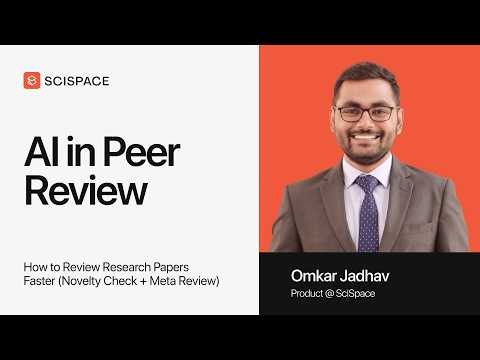 EN24 min
Use SciSpace to structure a peer review, compare manuscript claims with the reported methods and results, and draft clear reviewer comments. AI can organize checks and highlight possible inconsistencies, but it cannot replace disciplinary judgment, confidentiality rules, or the reviewer’s responsibility to distinguish major issues from optional suggestions.
 EN2 min
SciSpace AI Writer is most valuable when the evidence and argument are already defined. Provide the section goal, audience, notes, and allowed sources; generate or revise one section at a time; and then check every factual claim, citation, transition, and qualifier. Keep the researcher’s voice and do not allow the tool to invent results or references.
 EN2 min
Use SciSpace Paraphraser to rewrite academic text only after you understand the source. Preserve the original meaning, qualifiers, technical terms, and citation; compare the output sentence by sentence with the source; and revise any wording that overstates certainty, changes the claim, or disguises unattributed borrowing.
 EN3 min
SciSpace Citation Generator can format bibliographic data, but it cannot prove that the data are correct. Select the source and citation style, then compare author names, title, venue, year, pages, DOI, and URL with the publisher or trusted record. Check that every in-text citation has a matching reference and that no reference was fabricated.
El profesor Jefferson A. Moreno Guaicha enseña a revisar referencias con SciSpace y a elegir una revista acorde antes de enviar el artículo.
 TR43 min
Makalelerin reddedilmesine yol açan yaygın hataları yapay zeka desteğiyle göndermeden önce fark etmeyi ve gidermeyi öğrenin.
 中文34 min
 ID47 min
Pelajari alur kerja penulisan berbantuan AI di SciSpace, dari draf pertama, parafrase, dan sitasi hingga pemeriksaan deteksi AI.
 IT47 min
Il Prof. Giuseppe Biondi-Zoccai mostra come usare SciSpace in ogni fase della scrittura scientifica con rigore, trasparenza ed etica.
 FIL48 min
Ipinapakita ni Prof. Jessie Barrot kung paano gawing katuwang ang SciSpace AI sa pagsusulat nang hindi isinasakripisyo ang integridad.
Thesis Starter Pack tiga fase di SciSpace membantu mahasiswa menemukan research gap, merumuskan judul orisinal, dan menyusun Bab 1 hingga Bab 3.
 ES40 min
Tutorial en español sobre cómo incorporar las herramientas de IA de SciSpace a la redacción de manuscritos científicos sin perder el control del contenido.
 ID54 min
M Ilman Abidin membagikan alur kerja riset lintas disiplin dengan SciSpace untuk mempersingkat tinjauan literatur dan menyintesis temuan berbasis bukti.
 TR26 min
İlkem Kayican Dipcin, yapay zekâ desteğiyle makalelerde ret getiren yaygın yazım hatalarını fark edip düzeltmenin yollarını gösteriyor.
 TR42 min
İlkem Kayican Dipcin ile bir araştırma fikrini SciSpace desteğiyle adım adım yayımlanabilir bir makaleye dönüştürmeyi öğrenin.
Good academic writing is clear argument supported by accurate evidence. AI can help you outline, draft, paraphrase, format citations and spot weaknesses before reviewers do, but it cannot supply the thinking behind your paper, and careless use creates problems with accuracy, originality and disclosure.
This hub gathers SciSpace Academy's writing tutorials: writing a research paper guided, drafting introductions and methods from review results, discussion sections, avoiding common causes of manuscript rejection, choosing the right journal, and writing in a second language. Many tutorials are delivered in Spanish, Portuguese, Turkish, Indonesian, Italian and Filipino.
Most publishers allow AI assistance for language and structure but not as an author, and they require you to disclose how it was used. You remain responsible for accuracy, originality and every citation. Always check your target journal's policy before submitting.
Only cite papers you have located and read. Verify every reference against a database or the publisher's page, check that the cited paper actually supports your sentence, and use a citation tool that builds references from real records rather than generated text.