
Break the Language Barrier: AI Research Tools for ESL/EFL Researchers
TL;DR
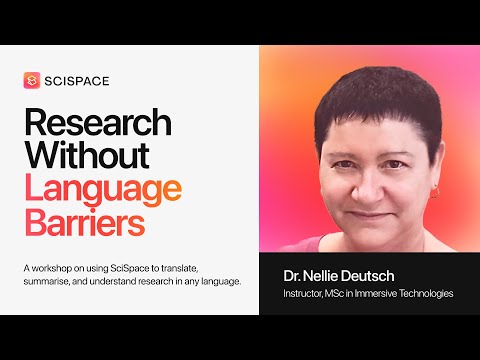
1-min readResearchers working in English as a second or foreign language must understand dense academic papers and then write about them clearly enough for international journals. In this hands-on tutorial, Dr. Nellie Deutsch (Ed.D), an ESL/EFL educator with more than 40 years of experience, past chair of TESOL CALL-IS and instructor on an MSc in Immersive Technologies, shows how SciSpace's AI tools can support both tasks. It is aimed at ESL/EFL students, researchers, thesis writers and faculty who mentor non-native English speakers.
Key takeaways
- AI tools can explain unfamiliar terms, summarise sections and answer questions about a paper in simpler language, helping you grasp the main points before returning to the original for details.
- Rephrasing dense research in your own words improves clarity, and it is not plagiarism when the idea is cited and the wording genuinely restates it.
- Lightly altered text or a missing source causes problems, so check any AI paraphrase against the original and add the citation.
- Structuring arguments and organising ideas before drafting helps your writing meet academic standards; short, clear sentences and outlines also help.
- Managing references and citations carefully keeps your writing credible and well formatted.
- Clearer research language builds confidence for publishing internationally, as long as you review AI suggestions so the meaning stays accurate and the ideas remain yours.
To apply this, open a difficult paper in SciSpace, ask it to explain the hardest section, then write your own summary and compare it with the source before citing.
How to do it
Open a difficult paper in SciSpace
Ask SciSpace to explain unfamiliar terms, summarise the hardest section and answer questions in simpler language. Grasp the main points before returning to the original for details.
Write your own summary
Restate the paper's ideas in your own words, then compare your summary with the source to confirm the meaning stays accurate.
Check paraphrases and add citations
Compare any AI paraphrase with the original and cite the source. Lightly altered text or a missing citation causes plagiarism problems.
Outline arguments before drafting
Structure your arguments and organise ideas in an outline, using short, clear sentences. This is central to academic writing for ESL researchers aiming at academic standards.
Manage references and citations carefully
Keep references and citations well managed and consistently formatted so your writing stays credible.
Review every AI suggestion
Check AI suggestions so the meaning stays accurate and the ideas remain yours. Clearer language builds confidence for international publishing.
Watch the tutorial45 min
Chapters
- Welcome and speaker introduction
- How AI can help ESL and EFL researchers with academic writing
- Tutorial goals: simplify papers, paraphrase and avoid plagiarism
- Why deadline pressure pushes researchers to copy-paste from AI
- What challenges do non-native English speakers face in academic writing?
- Why use SciSpace? AI Agent, My Library and citation generator
- Chat with PDF and the SciSpace podcast generator
- How can AI help ESL researchers understand complex papers?
- How can non-native speakers improve academic reading and writing?
- How to make SciSpace Agent explain research in simple English
- How to find relevant research papers with SciSpace Deep Review
- How to turn a research paper into a podcast in SciSpace
- AI literature review modes: Deep Review vs high quality vs standard
- How to paraphrase with AI and check it with an AI detector
- Free APA citation generator and using AI ethically
Try this on SciSpace
Literature Review Generator
Open agent →Literature Review Matrix
Open agent →Manuscript Writer
Open agent →
Frequently asked questions
How can non-native English speakers improve academic writing?
Read widely in your target journals and note common phrases and structures, write in short clear sentences, and outline arguments before drafting. AI tools can help explain difficult passages, suggest clearer wording and check grammar, but always review suggestions so the meaning stays accurate and the writing still reflects your own ideas.
Is paraphrasing with AI considered plagiarism?
Paraphrasing is not plagiarism when the idea is still cited to its original source and the new wording genuinely restates it. Problems arise when text is only lightly altered or the source is omitted. Use AI paraphrasing to understand and restate ideas, then check the result against the original and add the citation.
Can AI help me read difficult research papers in English?
Yes. AI tools can explain unfamiliar terms, summarise sections and answer questions about a paper in simpler language, which helps non-native readers grasp the main points faster. Use these explanations as support, then return to the original text for the details you plan to cite or build on.
Related tutorials
 EN27 minTutorial
Using AI in Scientific Writing: What to Delegate and What to Keep
Dr. Gali Halevi explains which parts of scientific writing AI can support and which decisions must stay with the researcher.
 EN33 minTutorial
Using AI in Scientific Writing Without Fake Citations
Dr. Ethan James Gantana explains how to use SciSpace in scientific writing while checking reliability and protecting citation integrity.
 EN58 minTutorial
From Notes to Draft with SciSpace Library and AI Writer
Omkar Jadhav shows how to organise sources in SciSpace Library and turn notes into a cited academic draft with AI Writer.