 EN37 min
Tutorial
Literature Review Workflow in SciSpace: Discover to Synthesize
Follow a four-stage SciSpace workflow that takes a literature review from semantic search to organised, citation-ready drafts.
 SciSpace Academy
31experts66tutorials11languages
A literature review is where most research projects either gain direction or stall.
Showing 66 tutorials
Go from a research question to a written synthesis: build a search strategy, screen papers, compare findings and write up themes, with every claim checked against the full text.
EN37 minFollow a four-stage SciSpace workflow that takes a literature review from semantic search to organised, citation-ready drafts.
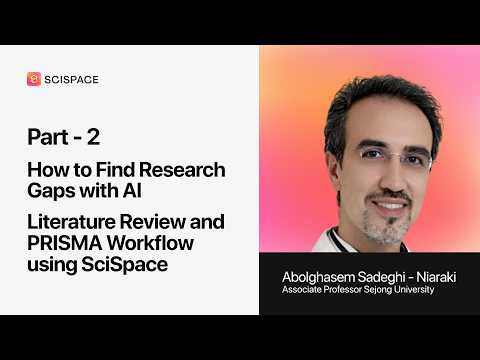 EN54 min
Dr. Abolghasem Sadeghi-Niaraki shows how SciSpace supports finding papers, spotting research gaps and building an evidence-based literature review.
 EN41 min
Dr. Abolghasem Sadeghi-Niaraki demonstrates how SciSpace helps you discover papers, extract insights and build a structured, evidence-based review.
 EN29 min
Learn how AI agents can take on search and screening steps of a literature review while you keep control of verification and interpretation.
Dr. Andy Stapleton walks through a repeatable, SciSpace-centred workflow for finding, analysing, organising and writing up literature.
 EN28 min
Dr. Nellie Deutsch demonstrates live how AI supports each literature review stage, and how to validate outputs and verify their sources.
 EN36 min
Statistician Dr. Lyndon Walker shows how to use AI agents to search, analyse, synthesise and validate papers while keeping every claim grounded.
Librarian Jonathan M. Torres shares evidence-based strategies for using generative AI and SciSpace in literature review, analysis, citations and prompting.
 EN40 min
A hands-on workflow for building a well-structured literature review from scratch with SciSpace Agent, from searching to synthesis and research gaps.
A full literature review workflow with SciSpace Agent, from setting criteria and extracting data to drafting sections and running quality checks.
 EN45 min
Dr. Faheem Ullah shows how SciSpace AI and its Agents speed up searching, analysing, synthesising and reporting in a literature review.
 EN31 min
Learn how SciSpace Agent takes a literature review from a precise question to a citable report using Deep Review Mode and Combined Paper Tables.
 EN54 min
Ilya Shabanov presents a repeatable SciSpace workflow for literature reviews, from research questions to bulk analysis, while avoiding hallucinations.
 EN24 min
A reliable AI-assisted literature review in SciSpace starts with a focused question and a documented search scope. Use SciSpace Literature Review to discover and filter papers, compare them in a consistent evidence matrix, inspect pivotal studies with Chat with PDF, and synthesize themes, disagreements, and gaps. Treat AI summaries as navigation aids and verify every important claim against the original paper.
 TH47 min
ใช้ AI ใน SciSpace ทบทวนวรรณกรรมทีละขั้นตอน ตั้งแต่ตั้งคำถามวิจัยจนถึงเขียนอย่างมีโครงสร้าง
 TR30 min
İlk arama sorgusundan atıflı rapora kadar, ajanlı ve ajansız yaklaşımları birleştiren bir SciSpace literatür tarama iş akışını öğrenin.
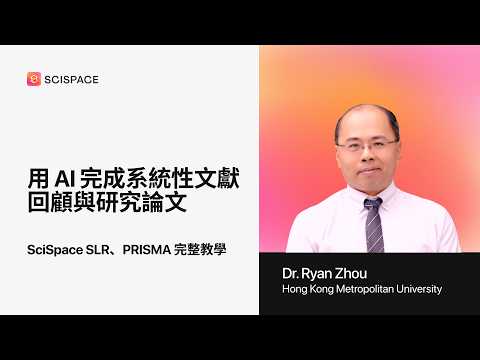 中文36 min
 TH32 min
เรียนรู้ขั้นตอนทบทวนวรรณกรรมบน SciSpace ตั้งแต่คำค้นแรกจนได้รายงานที่ตรวจสอบย้อนกลับไปยังแหล่งอ้างอิงได้
 IT52 min
Il Prof. Giuseppe Biondi-Zoccai presenta un workflow SciSpace per cercare, selezionare e sintetizzare gli studi in una revisione rigorosa.
 TR28 min
SciSpace ile ilgili makaleleri bulmaktan araştırma boşluklarını belirlemeye uzanan, tekrar kullanılabilir bir literatür tarama akışı kurun.
İlkem Kaviçan Dipçin, araştırma sorusundan yapılandırılmış rapora kadar literatür taramasını yapay zeka desteğiyle adım adım yönetmeyi gösteriyor.
 DE46 min
Danny Walther zeigt, wie der Literature Review Agent von SciSpace in vier Schritten von der Forschungsfrage zum strukturierten Literaturbericht führt.
 中文46 min
 TH32 min
วิดีโอสอนภาษาไทยที่สาธิตการใช้ SciSpace Agent ทบทวนวรรณกรรมตั้งแต่ตั้งคำถามวิจัยจนได้ร่างที่มีโครงสร้าง
 ID1 h 13 min
Diaramaku menguraikan alur tinjauan literatur berbantuan AI, dari pencarian hingga sintesis, dengan AI sebagai pendukung, bukan pengganti peneliti.
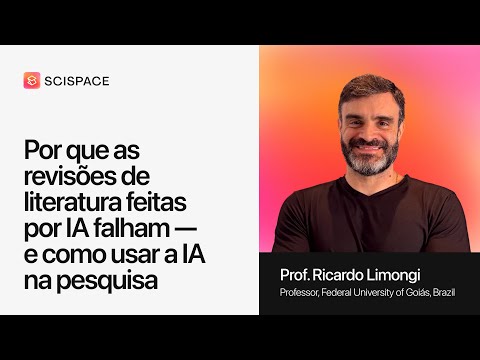 PT1 h 14 min
O Prof. Dr. Ricardo Limongi mostra como conduzir uma revisão bibliográfica com IA mantendo rigor acadêmico e controle intelectual do pesquisador.
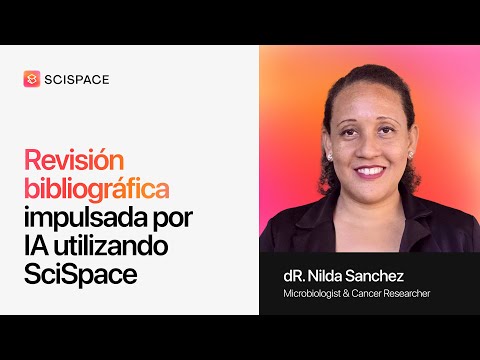 ES52 min
Nilda Sánchez muestra cómo usar SciSpace para revisiones de literatura más ágiles, profundas y ordenadas sin perder rigor académico.
 TR40 min
SciSpace AI Agent ile çoklu veritabanı araması, yapılandırılmış sentez ve araştırma boşluğu tespitini akademik dürüstlükten ödün vermeden öğrenin.
 PT29 min
Polyana Silva percorre uma revisão de literatura completa com o agente SciSpace, da busca de artigos à revisão final do texto.
Search beyond keyword matching: turn your question into a search strategy, surface relevant papers Google Scholar misses and narrow a long list down to the studies that matter.
See how an AI agent can turn one research question into several searches, then summarise and organise candidate papers for you to check.
Explore how AI search and synthesis can cut repetitive reading in literature reviews, and where human judgment remains essential.
 EN57 min
Dr Lyndon Walker shows how to use SciSpace search strategies to cut through large result sets and reach the papers that matter.
 EN5 min
Use SciSpace Literature Review to turn a focused question into a reviewable paper comparison, not to replace screening judgment. Search with explicit concepts and filters, inspect relevance, define custom comparison fields, compare methods and findings consistently, save the useful sources, and verify extracted evidence before using it in a review or decision.
 中文32 min
Ask questions of a PDF, decode methods and statistics, and read critically, so you understand a paper before you cite it.
 EN44 min
Hadiqa Maqsood demonstrates SciSpace Chat with PDF for summaries, jargon, equations, annotations and reading across the web.
 EN
Open a research paper in SciSpace Chat with PDF, ask a structured question about the study, and then narrow the conversation to methods, results, tables, figures, or limitations. Use the linked source context to verify important answers before moving them into your notes or writing.
 PT42 min
A professora Polyana Batista da Silva mostra como usar o SciSpace para uma leitura mais ativa e crítica de artigos científicos.
Pull the same fields from every paper into an evidence table, map theories and constructs, and turn the table into a synthesis organised by theme.
 EN47 min
Use SciSpace as a thinking partner to find, analyse and synthesise literature while strengthening your own critical judgment.
 EN1 h 56 min
Dr. Sowmiya Rani shows how AI can find literature, extract data from PDFs and synthesise findings before you start writing.
 PT30 min
A Dra. Polyana Silva mostra como usar o SciSpace para identificar teorias e construtos e fortalecer a base teórica do seu trabalho.
Use the literature to spot what has not been studied yet, test whether a gap is real and turn it into a novel, defensible research question.
 EN51 min
Prof. Erik Cambria presents AI as a thinking partner that helps researchers step outside habitual viewpoints and reframe research questions.
 EN47 min
Dr. Craig Palsson demonstrates a repeatable method for finding research gaps with Topic Finder, Deep Review and an AI notebook.
 ID45 min
Dr. Muhammad Ilman Abidin memandu cara memakai SciSpace untuk menemukan research gap dan novelty dalam hitungan jam, bukan minggu.
Triage a growing reading list, organise papers in a library and keep Zotero or Mendeley in sync, so nothing important gets lost.
 EN39 min
Learn an AI-assisted framework for organising, prioritising and synthesising hundreds of papers during a PhD without burning out.
 EN3 min
Use SciSpace Library as a project workspace: create a folder, add papers from PDF uploads, Zotero, or SciSpace search, compare papers with extracted columns, run Agent tasks using the folder as context, and save useful reports or insights to a Notebook.
Ubah koleksi Mendeley atau Zotero Anda menjadi pustaka aktif dengan ringkasan, Copilot, dan metadata yang lebih rapi di SciSpace.
Follow one project from literature search to submission with SciSpace Agent: search, review, analysis and drafting in a single, checkable workflow.
 EN36 min
A researcher-led walkthrough of using agentic AI in SciSpace to move from literature search to a submission-ready manuscript.
 EN38 min
Follow one research project through an end-to-end agentic workflow in SciSpace, from first search to journal submission, with human checkpoints throughout.
 EN43 min
Marija Đukić shows how she used SciSpace and repeated human-AI iteration to turn a large literature base into a structured maturity model.
 EN48 min
Learn how to use SciSpace Agent across a research project, from finding literature to drafting, while protecting rigour and your own voice.
 ES30 min
La Dra. Nilda Sánchez muestra cómo usar SciSpace Agent en cada etapa, desde buscar artículos hasta preparar el manuscrito para una revista.
 中文31 min
香港都會大學 Ryan Chou 博士示範如何以 SciSpace Agent 串起從文獻篩選到投稿準備的完整研究流程。
 TR37 min
İlkem Kayıcan Dipçin, bir araştırma fikrini yapay zeka desteğiyle sistematik bir literatür taramasına ve düzenli bir makale taslağına dönüştürmeyi gösteriyor.
Un flusso di lavoro agentico in SciSpace che accompagna il progetto dalla ricerca bibliografica all'invio, con il ricercatore sempre al comando.
 中文45 min
 中文1 h 8 min
Know what to delegate to AI and what must stay with you: verify sources, avoid fabricated citations and keep the judgement that evidence synthesis needs.
 EN42 min
A complete AI-assisted literature review in SciSpace, paired with practices that keep it rigorous, transparent and ready for scrutiny.
Dr. Olga Koz offers a practical roadmap for teaching and conducting literature reviews with AI while building real synthesis skills.
Paul Hassan Ilegbusi shows how SciSpace speeds up literature search and screening, and why over-reliance on AI summaries is risky.
 EN1 h 21 min
Professor Dawid Hanak walks through four literature review stages and shows how AI can support each one without compromising integrity.
Tinalakay ni Prof. Jessie Barrot kung paano gamitin ang AI sa literature review habang pinananatili ang paghuhusga ng tao at integridad bilang iskolar.
Find, interpret and evaluate clinical and biomedical studies with AI, with the extra care that health evidence demands.
Professor Benita Olivier shows clinicians how AI tools help locate, interpret and evaluate medical studies responsibly.
 EN33 min
Learn a guided SciSpace workflow for finding, extracting, comparing and verifying biomedical studies before you write your review.
EN33 minWith SciSpace Biomedical Agent, define the population or model, intervention or exposure, comparator, outcomes, evidence types, and intended use before searching. Extract study design, sample, methods, results, limitations, and safety information into a consistent table, separate unlike evidence types, and verify important values and conclusions in the original biomedical papers.
Use the SciSpace healthcare tutorial series as an evidence-based practice workflow: frame a clinical question, find recent evidence, inspect study methods and effect estimates, compare populations and interventions, and translate the evidence into a transparent decision. Keep patient context, applicability, uncertainty, and professional judgment visible at every stage.
 AR45 min
يوضح د. جوزيف جورج شنكجي أين يفيد الذكاء الاصطناعي البحث الطبي الحيوي، وأين يقصر، ولماذا يبقى حكم الباحث ضرورياً.
A literature review is where most research projects either gain direction or stall. You need to find the right papers, read far more than you have time for, and turn scattered findings into an argument. AI can speed up every one of those steps, but only if you keep control of the question, the sources and the synthesis.
This hub collects every SciSpace Academy tutorial on literature reviews. You will learn how to build a search strategy, screen and organise papers, extract findings into a comparison table, check claims against the full text with Chat with PDF, and write a synthesis that is organised by theme rather than paper by paper. Tutorials are led by researchers, librarians and SciSpace specialists, and many are available in Portuguese, Spanish, Thai, Chinese, Turkish, Indonesian and other languages.
AI can help you find papers, summarise them and organise evidence, but the research question, judgement about study quality and the final argument must be yours. Use AI outputs as a starting point, verify every claim against the original paper and disclose AI use according to your institution's or journal's policy.
There is no fixed number. It depends on your field, the scope of the question and the type of review. A focused thesis chapter may synthesise 30 to 60 sources, while a systematic review reports every study that meets its inclusion criteria. Prioritise relevance and quality over volume.