
How to Detect Fake AI Citations in Research: A Researcher’s Verification Checklist
Watch the tutorial36 min
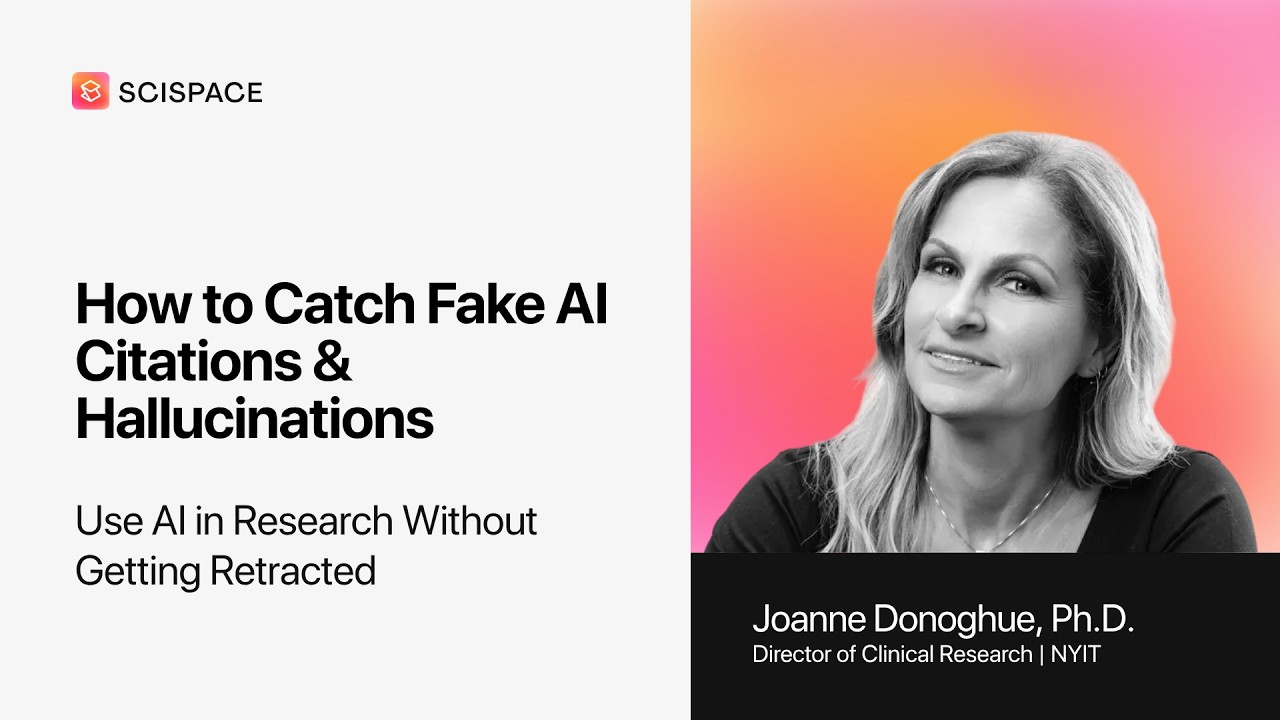
TL;DR
Learn how to check if AI citations are real, verify DOIs, and build a research workflow that keeps hallucinated references out of your papers.
Who it's for
This session is for PhD students, faculty, clinicians and anyone who uses AI tools to find literature or draft academic papers.
What you'll learn
- Verifying a DOI on doi.org and correcting wrong AI citations
- Running the same prompt in five AI research tools and comparing results
- Viewing the search terms SciSpace used, rerunning them in PubMed and writing a better prompt
- Cross-checking search results in SciSpace to find the strongest RCTs
- Chatting with your own verified PDFs in the SciSpace library instead of asking AI to supply references
- NotebookLM vs SciSpace for working with your papers
- Why a reference manager such as Zotero or Mendeley should build your reference list
Steps shown in the video
How a fake AI reference ends up in clinical guidelines
How to verify a DOI on doi.org and fix wrong AI citations
How to see which search terms SciSpace used, and write a better prompt
How to stop AI inventing references: chat with your own PDFs in SciSpace
Chapters
- Welcome and introduction
- Why are AI-hallucinated references rising in research papers?
- Why does AI make up fake citations? How LLM hallucinations happen
- How a fake AI reference ends up in clinical guidelines
- Can AI check your references for you? Why the author is responsible
- What does an AI-hallucinated citation look like?
- Is AI biased when it picks citations? Who is most at risk
- Four more ways AI hallucinates in research: GLP-1 examples
- What happens if your paper has fake references? Journal and arXiv rules
- How to verify a DOI on doi.org and fix wrong AI citations
- Same prompt in 5 AI research tools: why the results don't match
- How to see which search terms SciSpace used, and write a better prompt
- Cross-check AI search results in SciSpace to find the strongest RCTs
- How to stop AI inventing references: chat with your own PDFs in SciSpace
- NotebookLM vs SciSpace: which should researchers use for their papers?
- Can AI write your systematic review for you?
- Should AI format your reference list? Why use Zotero or Mendeley
Questions this video answers
Why are AI-hallucinated references rising in research papers?
She shows how a fake reference can reach clinical guidelines, what a hallucinated citation looks like, and four other ways AI goes wrong in research, including misquoted findings, invented statistics and false consensus, using GLP-1 examples.
Watch this part of the tutorialCan AI check your references for you? Why the author is responsible
Key takeaways: the author, not the AI, is responsible for every reference.
Watch this part of the tutorialWhat does an AI-hallucinated citation look like?
She shows how a fake reference can reach clinical guidelines, what a hallucinated citation looks like, and four other ways AI goes wrong in research, including misquoted findings, invented statistics and false consensus, using GLP-1 examples.
Watch this part of the tutorialWhat happens if your paper has fake references? Journal and arXiv rules
She also covers how journals and arXiv now respond to papers with fake references.
Watch this part of the tutorialNotebookLM vs SciSpace: which should researchers use for their papers?
NotebookLM vs SciSpace for working with your papers
Watch this part of the tutorialDo this in SciSpace
Do this in SciSpaceRelated tutorials
 EN39:40Tutorial
How to Disclose AI Use in Your Thesis or Research Paper
Professor Benita Olivier shows how to declare AI use at each stage of a real research workflow in SciSpace.
 EN45:01Tutorial
Using AI in Grants and Papers Without Raising Reviewer Red Flags
Learn which AI writing patterns raise red flags with grant and journal reviewers, and how to use AI while keeping your own voice.
 EN44:51Tutorial
Using AI Responsibly in Research: Trust, Evidence and SciSpace
Dr Sasha Nikolic explains how to assess AI output, verify citations and disclose AI use to protect academic integrity.