
Using SciSpace AI in Academic Research with Rigor and Integrity
TL;DR
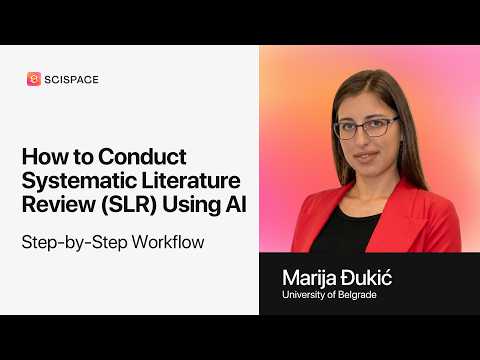
1-min readThis tutorial gives researchers and doctoral students an overview of AI-assisted research workflows together with clear integrity safeguards. It is led by Marija Đukić, Teaching Assistant in the Department of Information Systems at the Faculty of Organizational Sciences, University of Belgrade, and a doctoral student. The first half demonstrates SciSpace across the research process; the second half sets out what researchers should and should not do when AI is involved.
Key takeaways
- SciSpace can help you find and synthesise relevant literature faster, giving you a quicker route into a new topic.
- AI can support extracting insights from papers and using them to structure the arguments in your own work.
- The tutorial shows where AI can assist with drafting, coding and data analysis tasks, as well as with citations and manuscript formatting.
- Hallucinations, such as invented citations, misquoted findings or incorrect statistics, are a real risk, so every claim and reference should be checked against the original source.
- Keeping work reproducible means documenting which tools you used, for which tasks and with what prompts or settings, and keeping copies of key outputs.
- Researchers need to recognise where AI genuinely adds value, where human judgment is essential, and how to describe AI involvement in line with journal and institutional policies.
To apply this in SciSpace, use it for literature discovery and drafting support, verify each output against the source papers, and keep a simple log of tools and prompts for your methods section.
How to do it
Map the intended AI uses across discovery, reading, analysis, writing, and review.
Map the intended AI uses across discovery, reading, analysis, writing, and review. Record the benefit sought and the consequence of an error at each stage.
Define approved inputs, sources, methods, and prohibited actions for each stage.
Define approved inputs, source boundaries, methods, prohibited actions, and the person responsible for final decisions. Protect confidential or regulated material.
Create validation checks for citations, extracted data, calculations, and interpretation.
Create validation checks for citations, extracted data, calculations, code, interpretations, and disclosures. Match the strength of the check to the risk of the output.
Run pilot comparisons against human work and revise the workflow.
Run pilot comparisons against human work and review the failure patterns, not only average quality. Revise the workflow before wider adoption.
Retain documentation and prepare the appropriate disclosure.
Retain prompts, source links, outputs, changes, and review notes and prepare an accurate disclosure. The record should preserve methodological transparency and accountability.
Watch the tutorial
Try this on SciSpace
Literature Review Generator
Open agent →Find, Add & Audit Citations
Open agent →Plagiarism Checker
Open agent →
Frequently asked questions
What are AI hallucinations in research?
Hallucinations are outputs that sound plausible but are false, such as invented citations, misquoted findings or incorrect statistics. They occur because language models generate likely text rather than retrieving verified facts. Researchers should check every claim and reference against the original source before using it in a paper, grant or thesis.
How do I keep AI-assisted research reproducible?
Record which tools you used, for which tasks, and with what prompts or settings, and keep copies of key outputs. Verify results independently and describe AI involvement in your methods or acknowledgements according to journal and institutional policy. This lets others understand, evaluate and, where possible, repeat your process.
Related tutorials
- ENTutorial
Getting Started with SciSpace: A Complete Walkthrough for New Users
A beginner-friendly tour of the core SciSpace features for finding, reading and working with research papers, plus common mistakes to avoid.
 EN29 minTutorial
Build an AI-Driven Research Workflow: Your Academic Second Brain
Dr. Olarik Musigavong shows how to use SciSpace as an academic second brain for discovery, knowledge management and drafting.
 PT48 minTutorial
Como usar a IA do SciSpace na pesquisa acadêmica, passo a passo
O Prof. Dr. Ricardo Limongi demonstra como o SciSpace agiliza busca, leitura, organização e escrita, com uso ético da IA.