
Speed Up Your Scientific Research with an AI Agent
TL;DR
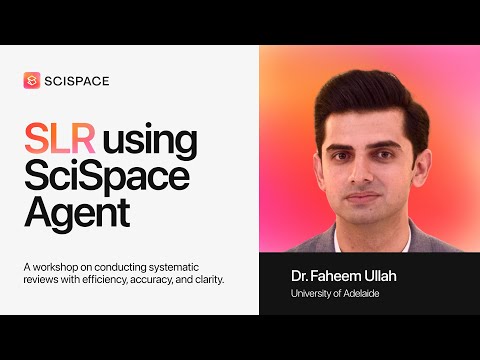
1-min readA large share of research time goes to work around the science rather than the science itself: reading and summarising papers, preparing visuals, drafting manuscripts and writing proposals. In this tutorial, Dr. Faheem Ullah, Assistant Professor and Cyber Security Program Director at the University of Adelaide, shows how the SciSpace AI Agent can speed up those tasks. It is aimed at early-career and senior researchers looking for practical ways to bring AI into their daily research process.
Key takeaways
- The agent can summarise and synthesise relevant literature quickly, giving you a faster overview of a topic before deeper reading.
- It can help you identify high-impact studies on your subject more efficiently than browsing results by hand.
- Findings can be turned into research posters and clear data visualisations; keep text short, lead with the key finding and check every number against your results.
- AI input can support drafting, refining and reviewing your own manuscript for clarity, structure and gaps, which differs from reviewing other people's confidential submissions.
- Research proposals, grant applications and funding pitches can be prepared faster with the agent's help.
- The agent works best with clear instructions and checked output, while study design, interpretation and scientific judgement stay with the researcher.
To apply this, pick one routine task such as summarising papers for a proposal, hand it to the SciSpace AI Agent with a clear instruction, and verify the result before you build on it.
How to do it
Summarise and synthesise research quickly
Ask the SciSpace AI Agent to summarise and synthesise papers on your topic. Using an AI agent for scientific research frees time for the science itself.
Identify high-impact studies
Use the agent to find high-impact studies on your topic more efficiently. This focuses your reading on what matters most.
Create posters and visualisations
Turn your findings into research posters and clear data visualisations with the agent. Good visuals communicate results quickly.
Draft and refine manuscripts
Use AI input to draft, refine and review your manuscript. Then check every claim against your sources.
Speed up proposals and grants
Apply the agent to research proposals, grant applications and funding pitches. This shortens time spent on these documents.
Watch the tutorial38 min
Chapters
- Welcome and agenda
- What is an AI agent? ChatGPT, Siri and Alexa explained
- Is there an AI agent built for research? SciSpace Agent
- Traditional research vs AI agents: literature review in 1 month, not 4
- How SciSpace Agent works: from prompt to downloadable PDF or PPT
- How to do a systematic literature review with AI
- SciSpace Agent vs ChatGPT for research tasks
- How to write a research or grant proposal with AI
- How to write a research paper with AI: manuscript draft with LaTeX export
- How to turn a research paper into a conference poster with AI
- Can AI peer review your research paper before submission?
- AI data visualization for research: from raw numbers to a dashboard
- AI literature review output: prompt and full PDF walkthrough
- AI-generated conference poster: final result
- AI peer review vs real journal reviewers: does the verdict match?
- Cautions for using AI in research: AI supports, it does not replace
- Academic integrity, plagiarism and data privacy when using AI
Try this on SciSpace
Literature Review Generator
Open agent →Literature Review Matrix
Open agent →Paper Summarizer
Open agent →
Frequently asked questions
How can an AI agent help with scientific research?
An AI agent can take on time-consuming tasks around research, such as summarising literature, finding relevant studies, creating visualisations, drafting manuscript sections and preparing proposals. It works best when you give clear instructions and check its output. Scientific judgement, study design and interpretation remain the researcher's responsibility.
Can AI help me make a research poster?
Yes, AI tools can help organise findings into a poster layout, suggest concise wording and generate charts from your data. Keep text short, lead with the key finding, and make sure figures are readable from a distance. Check every number against your results and follow the conference's size and format requirements.
Is it acceptable to use AI to review my own manuscript?
Using AI to check your own draft for clarity, structure and gaps before submission is generally acceptable and can catch problems early. This differs from reviewing other people's manuscripts, where many journals prohibit uploading confidential submissions to AI tools. Treat AI feedback as suggestions to evaluate, not instructions.
Related tutorials
- ENTutorial
Using SciSpace AI in Research with Rigor and Integrity
Marija Đukić shows where SciSpace fits across a research workflow and which safeguards keep AI-assisted work verifiable and transparent.
- ENTutorial
Getting Started with SciSpace: A Complete Walkthrough for New Users
A beginner-friendly tour of the core SciSpace features for finding, reading and working with research papers, plus common mistakes to avoid.
 EN1 h 16 minTutorial
SciSpace Research Agent: An End-to-End Research Companion
This launch tutorial shows how SciSpace Research Agent supports a project from literature search to analysis and drafting in one place.