
How Top Researchers Use AI Without Compromising Integrity
TL;DR
1-min readMany researchers want to use AI but worry about authorship, credibility and what their institution will accept. In this tutorial, Dr. Ali Hindi, Lecturer in Pharmacy Practice at the University of Manchester and an NIHR SPCR Postdoctoral Fellow, focuses on judgement rather than tools. It is aimed at master's and PhD students, early-career scholars and supervisors who are unsure where the ethical lines of AI use lie, especially when drafting a thesis, reviewing literature or preparing a manuscript.
Key takeaways
- Unethical use includes submitting undisclosed AI-generated text where disclosure is required, citing unverified references, fabricating or altering data, uploading confidential material to unapproved tools and using AI to write peer reviews.
- SciSpace's AI tools can support complex tasks while the researcher keeps responsibility for authorship, accuracy and originality.
- Most major publishers allow limited help such as language editing, do not accept AI as an author and often require disclosure, so read your target journal's author guidelines before submitting.
- AI-assisted workflows should be aligned with university policies as well as journal rules, since these differ and change over time.
- Recognising ethical risks early protects your credibility before a problem reaches a submission.
- Supervisors can set clear expectations about which tasks AI may support, how use is documented and how outputs are checked, using real examples of acceptable and unacceptable use.
To apply this, decide which tasks you will use SciSpace for, check each output against its sources, and record your AI use so you can disclose it when required.
How to do it
Distinguish ethical from unethical use
Assess each planned AI use against clear ethical criteria. Using AI in research with integrity starts with this distinction.
Use AI for complex tasks carefully
Apply SciSpace's AI tools to complex tasks while keeping authorship, accuracy and originality intact. Review all output as the author.
Align with policies and guidelines
Check your AI-assisted workflow against your university's policies and your target journal's guidelines. This keeps your work acceptable.
Spot ethical risks early
Look for ethical risks before they affect your credibility. Early detection is easier than correction.
Avoid common AI mistakes
Review the common mistakes researchers make with AI and adjust your practice. This protects your thesis or manuscript.
Watch the tutorial57 min

Chapters
- Welcome, speaker introduction and agenda
- Researchers' biggest AI worries: plagiarism, Turnitin and fake references
- What can AI do for researchers, and what can't it do?
- Can AI generate new research ideas? Why PhD applicants get caught
- Where is the ethical line for AI in research? Authorship criteria
- UNESCO, IBM and COPE AI ethics guidelines and how to disclose AI use
- Ethical vs unethical AI use in writing, literature review and peer review
- Which SciSpace tools to use for literature review, summarizing and writing
- SciSpace Google Scholar extension for a quick literature scan
- AI literature search table: summarize objectives, methods and research gaps
- How to use SciSpace Deep Review for a focused literature review
- How to organize and track papers with SciSpace Library
- Is AI search enough for a systematic review? Use PubMed and Scopus too
- Deep Review results: paper table, critical analysis and themes
- Chat with PDF with sources: how to verify AI paper summaries
- How to use an AI writer ethically: start from your own first draft
- Cite while you write from your SciSpace Library
- Ethical vs unethical AI writing prompts: the golden rule
- Will I get in trouble for using AI? University and journal AI policies
- Are AI detectors like Turnitin reliable? A journal editor's view
- Common AI mistakes: hallucinations, fake citations and no disclosure
- Why AI always agrees with your hypothesis: confirmation bias
- AI is a tool, not an author: key takeaways and resources
Try this on SciSpace
Plagiarism Checker
Open agent →Find, Add & Audit Citations
Open agent →Literature Review Generator
Open agent →
Frequently asked questions
What counts as unethical use of AI in research?
Common examples include submitting AI-generated text as your own without disclosure where it is required, citing references you have not verified, fabricating or altering data, uploading confidential material to unapproved tools and using AI to write peer reviews. Ethical use keeps the researcher responsible for ideas, accuracy and transparency.
Do journals allow AI-assisted writing?
Most major publishers allow limited AI assistance, such as language editing, but do not accept AI tools as authors and often require disclosure of how AI was used. Policies differ between publishers and change over time, so read your target journal's author guidelines before submission and follow them exactly.
How can supervisors guide students on AI use?
Supervisors can set clear expectations early: which tasks AI may support, how use should be documented and how outputs must be checked. Discussing real examples of acceptable and unacceptable use, and pointing students to institutional policy, helps them benefit from AI while protecting the integrity of their thesis.
Related tutorials
 EN39 minTutorial
How to Disclose AI Use in Your Thesis or Research Paper
Professor Benita Olivier shows how to declare AI use at each stage of a real research workflow in SciSpace.
 EN45 minTutorial
Using AI in Grants and Papers Without Raising Reviewer Red Flags
Learn which AI writing patterns raise red flags with grant and journal reviewers, and how to use AI while keeping your own voice.
 EN36 minTutorial
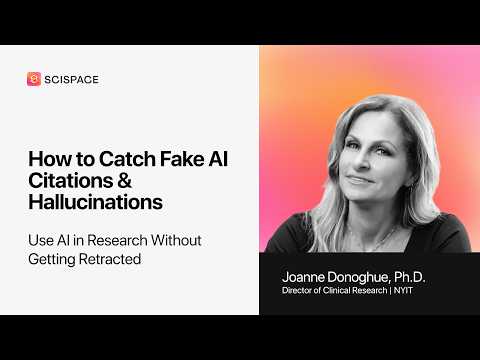
How to Detect Fake AI Citations: A Researcher’s Verification Checklist
When SciSpace or another AI system suggests a reference, confirm that the source exists and supports the claim before using it. Resolve the title, authors, venue, year, pages, and DOI in trusted records; open the source; check the relevant passage; and remove or correct any citation that is fabricated, mismatched, or irrelevant.