 EN44 min
Tutorial
Using AI Responsibly in Research: Trust, Evidence and SciSpace
Dr Sasha Nikolic explains how to assess AI output, verify citations and disclose AI use to protect academic integrity.
 SciSpace Academy
Tutorials
Free tutorials from expert researchers for literature reviews, systematic reviews, data analysis, writing and grants. See live tutorials
Showing 129 tutorials · page 2 of 6 · Clear filters
EN44 minDr Sasha Nikolic explains how to assess AI output, verify citations and disclose AI use to protect academic integrity.
 EN49 min
Learn a structured way to plan and run a rapid or systematic review with SciSpace so evidence synthesis is faster but still methodical.
Plan a systematic literature review that uses SciSpace to speed up routine tasks while you keep control of methodological decisions.
 EN35 min
Dr. Loreta Tauginienė examines the ethical, legal and methodological risks of AI transcription and anonymisation in qualitative research.
 EN38 min
Follow a SciSpace workflow for finding open datasets, running multi-step statistical analyses and reporting results within data governance rules.
 EN41 min
Avi Staiman shares a guided method for moving from a research question to PRISMA-ready systematic review outputs faster with AI.
 EN37 min
Dr. Joanne Donoghue explains how to define esports populations precisely and use AI workflows to move from research idea to protocol and journal.
 EN39 min
See how SciSpace can speed up each stage of a systematic review while you keep control of criteria, verification and interpretation.
 EN54 min
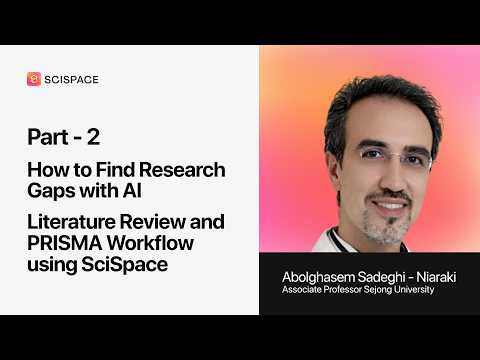
Dr. Abolghasem Sadeghi-Niaraki shows how SciSpace supports finding papers, spotting research gaps and building an evidence-based literature review.
 EN47 min
Use SciSpace as a thinking partner to find, analyse and synthesise literature while strengthening your own critical judgment.
Marija Đukić shows where SciSpace fits across a research workflow and which safeguards keep AI-assisted work verifiable and transparent.
 EN41 min
Dr. Abolghasem Sadeghi-Niaraki demonstrates how SciSpace helps you discover papers, extract insights and build a structured, evidence-based review.
 EN34 min
Professor Sid Dobrin explains how emerging AI regulations and journal policies affect disclosure, authorship and transparency in research.
 EN41 min
Editor-in-Chief Professor Roger Watson explains how editors assess AI-assisted manuscripts and what disclosure they expect.
Paul Hassan Ilegbusi shows how SciSpace speeds up literature search and screening, and why over-reliance on AI summaries is risky.
 EN33 min
Dr. Ethan James Gantana explains how to use SciSpace in scientific writing while checking reliability and protecting citation integrity.
 EN35 min
SciSpace Research Scientist Rohan Tondulkar demonstrates a transparent, guided systematic review workflow combining established methods with AI tools.
 EN29 min
Learn how AI agents can take on search and screening steps of a literature review while you keep control of verification and interpretation.
 EN51 min
Prof. Erik Cambria presents AI as a thinking partner that helps researchers step outside habitual viewpoints and reframe research questions.
Dr. Andy Stapleton walks through a repeatable, SciSpace-centred workflow for finding, analysing, organising and writing up literature.
A beginner-friendly tour of the core SciSpace features for finding, reading and working with research papers, plus common mistakes to avoid.
 EN29 min
Dr. Olarik Musigavong shows how to use SciSpace as an academic second brain for discovery, knowledge management and drafting.
Professor Benita Olivier shows clinicians how AI tools help locate, interpret and evaluate medical studies responsibly.
Professor Benita Olivier breaks research paper writing into manageable stages, using SciSpace for literature, structure and drafting while keeping AI use responsible.