SciSpace Academy

Level: All levels · 6 lessons

Responsible AI in Research in 6 Lessons

Everything you need to use AI without risking your integrity: trust and evidence, hallucinated citations, AI detection, regulations, rigour and disclosure.

Start lesson 1

Lessons

  1. Using SciSpace Responsibly: Trust, Evidence and AI in ResearchEN
    Lesson 1Tutorial

    Using SciSpace Responsibly: Trust, Evidence and AI in Research

    When SciSpace generates a research answer, verify it by separating extracted evidence, synthesis, inference, recommendation, and unknowns. Open the supporting sources, confirm that each exists and supports the claim, check methods and numbers, compare contradictory evidence, and label uncertainty before using the answer in research or decisions.
  2. How to Detect Fake AI Citations: A Researcher’s Verification ChecklistEN36 min
    Lesson 2Tutorial

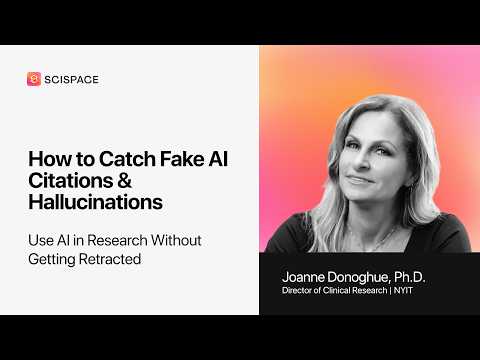
    How to Detect Fake AI Citations: A Researcher’s Verification Checklist

    When SciSpace or another AI system suggests a reference, confirm that the source exists and supports the claim before using it. Resolve the title, authors, venue, year, pages, and DOI in trusted records; open the source; check the relevant passage; and remove or correct any citation that is fabricated, mismatched, or irrelevant.

  3. How to Use an AI Detector for Academic Writing: Limits and Best PracticesEN3 min
    Lesson 3Tutorial

    How to Use an AI Detector for Academic Writing: Limits and Best Practices

    Use SciSpace AI Detector as a screening signal, not proof of authorship or misconduct. Review flagged passages in context, compare them with drafts, sources, and citation patterns, consider false positives for formulaic or multilingual academic prose, and rely on transparent institutional procedures rather than a single detector score.

  4. AI and Research Integrity: Navigating Global Regulations in 2026EN35 min
    Lesson 4Tutorial

    AI and Research Integrity: Navigating Global Regulations in 2026

    When SciSpace is used in regulated research, obligations may come from law, institutional policy, ethics approval, funder terms, journal rules, and data agreements. Map the exact use case, data type, jurisdiction, decision impact, and required documentation before adoption, and keep a human accountable for approval and oversight.

  5. Using SciSpace AI in Academic Research with Rigor and IntegrityEN
    Lesson 5Tutorial

    Using SciSpace AI in Academic Research with Rigor and Integrity

    Use SciSpace in academic research where it improves speed or consistency without obscuring methods, evidence, or accountability. Map its role across discovery, reading, analysis, and writing; protect sensitive data; verify outputs proportionately to risk; preserve researcher judgment; and disclose material use when required.

Try this on SciSpace

Use case: Responsible AI